Curriculum and Assessment

Selecting the right skills and knowledge and choosing the right times to teach them is really important in getting pupils at Oak Field ready for their adult lives. Therefore, the curriculum is designed to be responsive to each learner, and build on individual strengths and interests. Recognising, celebrating and planning for pupils’ personal needs and aspirations is central to the curriculum that they learn and experience. The curriculum focuses on developing the key skills of communication, expression, physical development, and self-care, all transferrable skills that equip children and young people for life beyond the school.

Progression maps and curriculum sequences reflect the stage (not age) approach; knowledge organisers support a balance of stimulating contexts for progression through different learning experiences, themes and subjects. Follow these links to find out more about each age groups topics, or explore the progression maps that guide us.
Learning in the 3 – 7 Phase encourages our pupils to become confident and curious learners with a focus on developing their learning skills.  We promote the development of independence skills by creating an environment which is responsive to the pupils’ needs and which supports the positive relationships through which our pupils can thrive.  Our learning is predominantly in the prime areas of the curriculum: communication & language, personal, social and emotional development, and physical development.  The specific areas of the curriculum provide enhancements and opportunities for experiential learning that is so valuable to our pupils’ awareness of the world around them.

Book Based Curriculum

Year 1 (2022-2023)Year 2 (2023-2024)Year 3 (2024-2025)Year 4 (2025-2026)
Autumn 1Going on a Bear Hunt, Michael RosenThe Tiger who came to Tea, Judith KerrElmer, David McKeeThe Gruffalo, Julia Donaldson
Autumn 2The Elves and the ShoemakerLittle Red Riding HoodThe Gingerbread ManGoldilocks and the Three Bears
Spring 1Pip and Posy, Axel ShefflerPirates Love Underpants, Claire FreedmanStomp, Chomp, Big Roars! Here Come the Dinosaurs, Kaye UmanskyMagic Train Ride, Sally Crabtree
Spring 2Hungry Caterpillar, Eric CarlHanda’s Surprise, Eileen BrowneKitchen DiscoClare FogesReal Superheros, Julia Seal
Summer 1Five Minutes Peace, Jill MurphyMartha Maps it Out, Leigh HodgkinsonHooray for Fish, Lucy CousinsLittle Glow, Katie Sahota
Summer 2Magic Train Ride, Sally CrabtreeJabuti the Tortoise. Gerald McDermottWalter’s Wonderful Web, Tim HopgoodOff to the Park, Stephen Cheetham

*Additional books to support the theme chosen specifically on cohort of pupils to provide opportunities to explore children’s interest.

In our 3 – 7 years phase, pupils have access to 10 continuous provision learning areas. Each of these areas is linked to the EYFS curriculum and has been carefully considered to ensure a breadth of delivery.   Some areas include; messy mark making, reading corner, role play corner and a discovery zone.  Pupils have opportunities for learning in all these areas throughout the week.  Our continuous provision plans highlight key learning opportunities in each continuous provision area, resources and organisation.  Although the core resources remain the same throughout the year, each term topic enhancements are changed and link directly to our half termly book topic.  In addition to the continuous provision plans, pupils also access a focused learning activity linked to the book topic and curriculum map.

CURRICULUM MAP 2023-2024

Phase 3-7 Curriculum Map Y3

Continuous Provision Planning

The curriculum in Phase 7-14 builds on the foundations of learning developed in EYFS and KS1. Pupils continue to work on their learning to learn skills.  These skills are  closely linked to their EHCP outcomes. Pupils have opportunities to practise, develop and transfer the skills through  exploring a wide range of themes. The themes provide a broad, stimulating and rich environment to inspire and motivate the pupils.

KS2 Rolling programme

Autumn 1Autumn 2Spring 1Spring 2Summer 1Summer 2
2021 - 2022Homes and habitatsOur world and beyondGrowing upEuropeReduce reuse recyclein the desert
2022-2023 People and work It’s cold outside Health and fitness Poems and rhymes Egyptians Forests and jungles
2023-2024My local communityExperiments and inventionsVikingsAuthors and illustratorsGrowingOlympics/paralympics
2024-2025myselfSounds and lightsMy global communityKeeping safeMyths and legendsWater

KS3 Rolling programme

Autumn 1Autumn 2Spring 1Spring 2Summer 1Summer 2
2021 - 2022Autumn and WeatherElectricity and EnergyTraditional TalesAir and SpaceSouth AmericaBritish Isles
2022-2023Nottingham and local environmentWinter and Polar Regions of the WorldWar and PeaceWorld PoetryEurope and Renaissance ArtDeserts, including the Middle East
2023-2024Me and my communityLight, Camera and ActionChinaSpring and WeatherAfricaOceans and Climate

Curriculum Map KS2 2023 – 2024

Learning in Key Stage 4 focuses on team work, community projects and building autonomy.

Including:

Practical English and maths, focused on life skills.

Working in groups on projects that involve planning, working together, like hosting exhibitions, coffee mornings and fundraisers.

Developing careers knowledge, work skills and understanding job roles.

Using and creating stories and drama to explore PSHE including Relationships and Sex Education.

Regular physical activity.

Key Stage 4 Curriculum Map

Learning in the 6th Form focuses on community-facing skills and applying skills in more contexts, more independently.

Including:

Communicating and spending time a wide range of people, especially others within the wider community.

Applying practical English and maths skills to problem solve in work and leisure contexts.

Developing work and enterprise skills in realistic contexts.

Using the Arts to celebrate diversity, achievements and communication.

Building on the foundations to date of Relationship and Sex Education, promoting safe and fulfilling relationships with others.

Regular physical activity.

6th Form Curriculum Map

Curriculum Sequences

(Phase 7-14 and 14-19)

Building on from the Oak Field Steps for Assessment, Curriculum Sequences have been developed to cover the  different strands of the curriculum taught . These sequences support and scaffold the pupil’s learning from early engagement through to the start of the National curriculum levels. Each step in the sequence builds from initial acquisition of skills through exploring and experiencing activities,  to making clear and  definite choices and then onto applying and using skills  in different contexts.  Some examples are given below – for all strands please contact the school for further information.

Curriculum Sequence English Writing

Curriculum Sequence Geography Places And Landmarks

Knowledge Organisers

(Phase 7-14 and 14-19)

For each topic taught there are knowledge organisers that outline the areas to be covered and  key vocabulary to be focused on. These are used along with the curriculum sequences to plan topics building on sequences of learning.  Some examples are given below – for further information please contact the school.

Our intent is that each pupil should access a curriculum that is personal to them, yet closely linked with social and community opportunities to learn alongside others.

Our curriculum is designed especially to support our pupils to develop their communication skills so that they have a voice, and understand the importance and power of their voice being heard. Our curriculum inspires and encourages pupils to develop a wide range of skills, to support and enable them to become active and valued members of their local and wider communities when they leave school.

As a school we want to make sure that all our pupils have access to a fun, rich, diverse and broad curriculum – we use motivating and relevant topics and themes as vehicles for all of our pupils to develop learning skills, and for some of our pupils to develop subject specific knowledge. We want to make sure that our curriculum is responsive to our pupils’ needs but also flexible, so that we can take advantage of opportunities that arise each year, including incorporating significant events, such as Black History Month and the different context for learning offered through our annual Christmas Show.

The journey may change direction, according to a pupil’s strengths, needs and enthusiasms, but each decision about where their journey is taking them is based on a clear and collaborative understanding of where they are, where they are going and why.

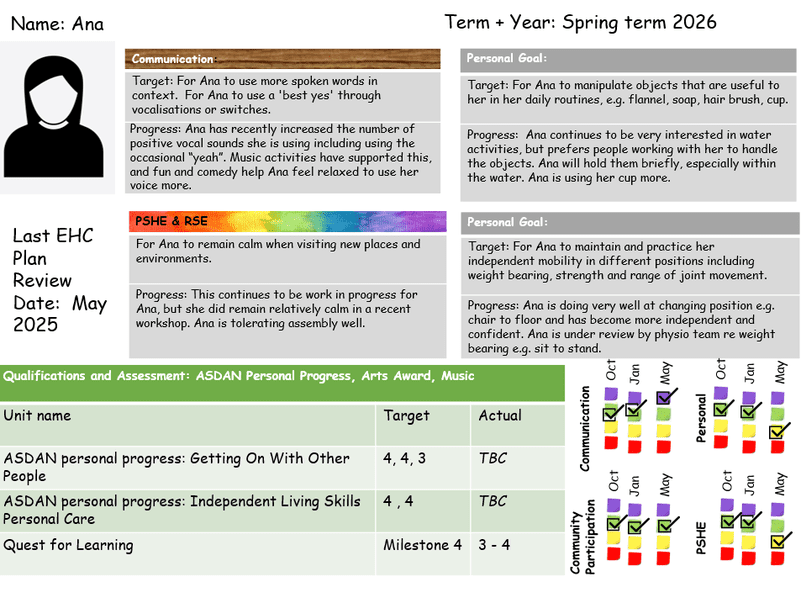
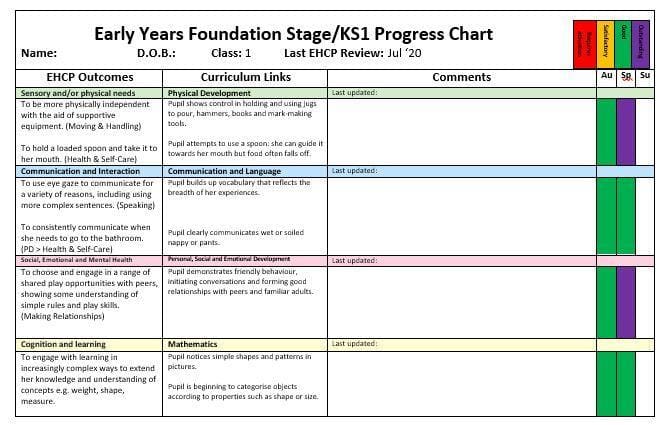
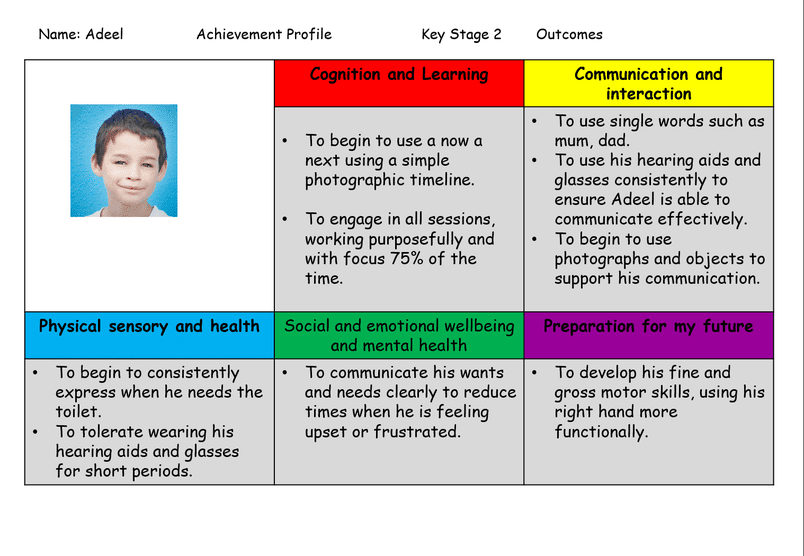
These documents help teachers to plan and share with families and school teams’ the personal goals for each pupil. They are carefully linked to Education, Health and Care plans. For older children they include goals for accreditation and awards.

Learning Journeys and Achievement Profiles are used to record community participation and experiences, which help to make sure children are taking part in events relevant to them.

Example page from Achievement Profile (EYFS/KS1)

Example page from Achievement Profile (7-14 Phase)

Example page from Achievement Profile (14-19 Phase)

Communication Profiles

Many pupils have a Communication Profile to help teachers and professionals detail their communication strengths and next steps as they progress through school.

Privacy Overview
Oak Field School

This website uses cookies so that we can provide you with the best user experience possible. Cookie information is stored in your browser and performs functions such as recognising you when you return to our website and helping our team to understand which sections of the website you find most interesting and useful.

Strictly Necessary Cookies

Strictly Necessary Cookie should be enabled at all times so that we can save your preferences for cookie settings.

Third Party Cookies

This website uses Google Analytics to collect anonymous information such as the number of visitors to the site, and the most popular pages.

Keeping this cookie enabled helps us to improve our website.